

What Really Matters in a Palm Oil Fractionation Line
Palm oil fractionation is a process where profitability is determined by small differences in equipment design. The ability to consistently separate palm olein from palm stearin at high yield depends not on a single component, but on how the crystallizer, cooling system, agitator design, filtration equipment, and automation work together. Many conventional fractionation lines share similar-looking flowcharts, yet their real-world performance differs substantially.
Ocean has designed, built, and commissioned more than 40 fractionation lines across China and international markets, holding the largest market share in the country. Based on direct project comparisons and decades of operational data, we explain below why certain design choices lead to measurable advantages in product yield, energy efficiency, and long-term reliability.
Crystallization Control: Where the Real Difference Begins
Crystallization is the most critical stage in any fractionation line. The size, shape, and uniformity of crystals formed during cooling directly determine how effectively the filter press can separate olein from stearin. Poor crystallization leads to slow filtration, high oil retention in the stearin cake, and inconsistent product quality.
Ocean’s approach to crystallization control focuses on three interconnected elements: cooling surface distribution, agitation design, and temperature curve programming.
Internal Cooling Coils vs. Jacket Cooling
The method used to remove heat from the oil has a profound impact on crystal growth. Many conventional designs rely on jacket cooling – a simple external shell through which cooling water circulates. While jacket cooling is less expensive to manufacture, it suffers from several limitations. The heat exchange area is restricted to the vessel’s external surface, which becomes increasingly insufficient as crystallizer size increases. More importantly, jacket cooling creates temperature gradients: oil near the vessel wall cools much faster than oil in the center, leading to uncontrolled crystal nucleation and wide crystal size distribution.
Ocean, in contrast, uses internal cooling coils made from seamless SS304 tubes. These coils are distributed throughout the crystallizer volume, providing a much larger heat exchange surface. With active mechanical agitation, the cooling medium inside the coils contacts moving oil uniformly, eliminating temperature gradients. The result is a controlled, uniform supersaturation field where crystals nucleate simultaneously and grow at similar rates – the prerequisite for sharp separation during filtration.
Agitator Design: Scrapers Are Not Optional for Certain Oils
For palm oil fractionation, especially when producing lower-IV olein (e.g., 18°C or 14°C cloud point products), the oil becomes increasingly viscous as temperature drops. In conventional designs without scrapers, a layer of partially crystallized oil adheres to the cooling surfaces, acting as an insulating barrier that progressively reduces heat transfer efficiency. This forces operators to extend cycle times or accept incomplete crystallization.
Ocean equips its crystallizers with frequency-controlled frame agitators fitted with PTFE scrapers. The scrapers continuously clean the cooling coils and vessel walls, maintaining high heat transfer efficiency throughout the entire cooling cycle. The agitator speed is automatically varied by the PLC: faster during the initial cooling stage to promote uniform nucleation, and slower during the maturation phase to avoid breaking delicate crystals. This combination of scrapers and variable-speed agitation is not found in many conventional designs, yet it directly translates to shorter cycle times and higher throughput.
Pre-Programmed Crystallization Curves
Perhaps the most underestimated advantage of a modern fractionation line is the ability to control the cooling profile with precision. Crystallization is not a simple linear cooling process. The optimal profile typically involves rapid cooling to a temperature just above the cloud point, followed by a slow, controlled temperature decline through the crystal formation zone, and finally a constant-temperature maturation period.
Ocean’s automation system stores multiple pre-programmed crystallization curves for different feedstocks and target olein iodine values. Once the operator selects the appropriate recipe, the PLC executes the entire sequence automatically – adjusting chiller setpoints, modulating cooling water flow, varying agitator speed, and logging temperatures at multiple points within the crystallizer. This removes operator guesswork and ensures that every batch follows the same proven cooling profile.
Some conventional designs rely on manual temperature adjustments based on wall-mounted thermometers. This approach inevitably produces batch-to-batch variation, compromises yield, and makes it difficult to troubleshoot or scale up new products. With Ocean’s automated crystallization control, customers achieve consistent results regardless of which shift operator is on duty.
Filtration: Membrane Technology for Higher Olein Recovery
After crystallization, the slurry must be separated into liquid olein and solid stearin. The filtration system’s design has a direct impact on product yield, labor requirements, and filter cloth life.
Many conventional fractionation lines use standard plate-and-frame filter presses without membrane squeezing. In these designs, the solid stearin cake is formed simply by pumping the slurry against the filter cloth. Once the cake reaches a certain thickness, pumping stops, and the cake contains a significant amount of entrapped olein – typically 15–25% of the cake weight. This olein is permanently lost to the stearin stream, reducing overall yield.
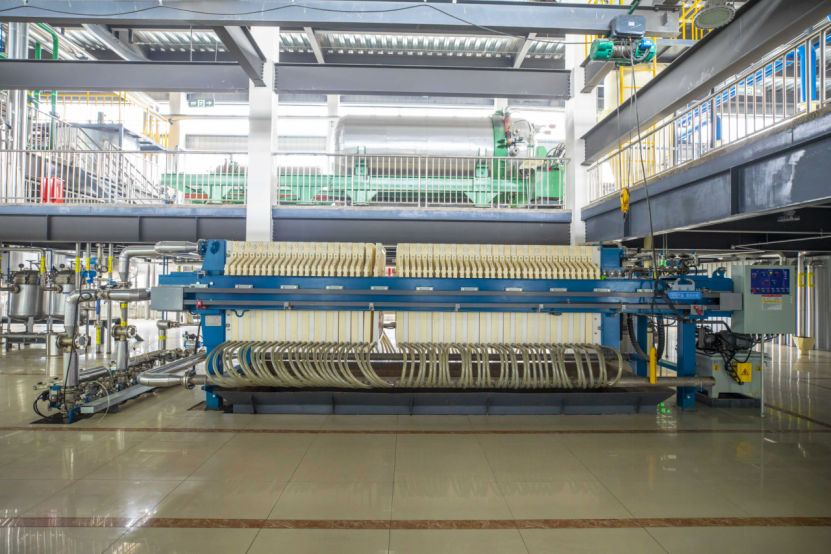
Ocean’s fractionation production line specifies membrane (diaphragm) filter presses as standard equipment. After the initial cake formation, water or compressed air is introduced behind the flexible membrane, physically squeezing the cake against the filter plates. This squeezing action reduces residual olein in the stearin cake to as low as 8–12%, directly increasing olein yield by 2–4 percentage points. For a medium-sized fractionation plant, this yield improvement can add hundreds of thousands of dollars in annual revenue.
The entire filtration cycle – filling, circulation, filtration, venting, membrane squeezing, cake blowing with compressed air, and automatic discharge – is fully sequenced and controlled by the PLC. Hydraulic plate shifting and automatic cloth washing options further reduce labor intensity. Some conventional designs require operators to manually scrape stearin from frames, a messy and time-consuming task that also exposes the product to ambient air, accelerating oxidation.
Conclusion
When evaluating a palm oil fractionation line, price is only one factor. The real value lies in design choices that affect crystallization uniformity, filtration efficiency, automation capability, and long-term material integrity. Ocean’s approach – internal cooling coils with scrapers, pre-programmed crystallization curves, membrane filter presses, independent vacuum systems, and full PLC/HMI automation – is the result of decades of experience and over 40 fractionation installations.
