

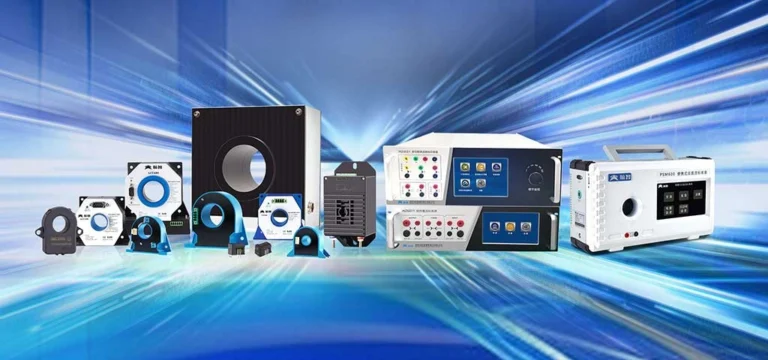
The right current measurement technology depends on four questions: what current range must be measured, whether the waveform contains DC and fast transients, how much isolation is required, and what level of accuracy the system can tolerate. Shunts can provide precise low-current measurement but introduce insertion resistance; conventional current transformers work well with AC but cannot directly measure steady DC; Hall-based solutions handle AC and DC with relatively flexible integration; and closed-loop fluxgate designs are suited to applications demanding high accuracy, isolation, and broad waveform coverage.
These distinctions make Current Measurement Technologies easier to evaluate according to actual system requirements rather than product category alone. Hangzhi focuses on precision current and voltage transducers built around multi-point zero-flux control, with published specifications covering 1 A to 30 kA, accuracy reaching 10 ppm, and bandwidth up to 500 kHz.
Start With Electrical Requirements for Current Measurement Technologies
Current range should be established before comparing sensing principles. Nominal current alone is insufficient because industrial equipment can experience startup surges, overloads, regenerative operation, or bidirectional power flow. The selected device needs a specified measurement range that corresponds to the expected waveform while leaving appropriate consideration for transient conditions.
Voltage isolation is equally important in high-voltage environments. A sensing method may provide electrical separation between the primary and secondary circuits, but the required isolation level, creepage, clearance, insulation category, and installation conditions still need separate review. Measurement accuracy has little practical value if the sensing arrangement does not fit the system’s safety architecture.
Signal characteristics narrow the field further. A system carrying only steady AC at a known frequency can use a different approach from an inverter producing DC, switching ripple, and rapid current transitions. Closed-loop fluxgate sensing is particularly relevant to complex AC/DC waveforms because it combines compensation-based measurement with galvanic isolation and precision performance.
Compare The Main Sensing Approaches
A shunt measures current through the voltage developed across a known resistance. Its straightforward electrical principle can support accurate measurement, especially at lower current levels, but the resistor introduces power dissipation and a voltage drop into the primary circuit. Those effects become increasingly significant as current rises.
Current transformers rely on magnetic coupling and are widely used for AC measurement. Their natural limitation is that steady DC does not produce the changing magnetic flux required for conventional transformer action. Hall-effect sensors overcome that limitation by responding to magnetic fields associated with both AC and DC, making them useful in many industrial systems, although precision requirements may call for more sophisticated architectures.
Closed-loop fluxgate systems add active compensation. The primary current generates magnetic flux, a detector identifies the residual flux, and a secondary winding produces a compensating current that drives the core toward a near-zero-flux condition. Hangzhi’s multi-point zero-flux control extends this principle by combining excitation-flux closed-loop control, self-excited fluxgate technology, and multiple closed-loop controls to maintain measurement performance across the working range.
This arrangement supports isolated measurement of DC, AC, pulsed, and complex waveforms, which is why it appears in high-precision power analysis, metrology, and inverter applications. For high-voltage industrial systems, comparing these current measurement technologies should therefore consider isolation, waveform, and accuracy requirements together.
Look Beyond Nominal Accuracy
Accuracy should never be evaluated by itself. Offset, linearity, temperature drift, long-term stability, noise, and bandwidth can all contribute to the actual measurement result. A sensor with a very attractive accuracy figure may not be suitable if its temperature behavior or frequency response does not match the application.
Temperature deserves particular attention in industrial installations. Equipment can move from standby to full load, operate in enclosed cabinets, or experience seasonal environmental changes. A specification expressed in ppm/K provides information about temperature sensitivity, while time-related drift indicates how measurement behavior may change over longer periods.
Bandwidth becomes critical once switching frequencies and transient currents enter the picture. A renewable-energy inverter, for example, may require accurate monitoring of both its DC input and rapidly changing current on the conversion side. Fluxgate Current Sensors can be particularly useful in such environments because closed-loop fluxgate architectures are designed for precise AC/DC measurement across a defined frequency range.
Consider High-Voltage Application Details
High-voltage industrial systems require more than a suitable current range. Isolation, installation geometry, conductor placement, electromagnetic compatibility, output interface, thermal conditions, and mechanical mounting can all influence the final measurement arrangement. These details should be reviewed before a sensor is integrated into an operating cabinet or test platform.
Renewable-energy equipment demonstrates why several parameters often need to be considered simultaneously. Solar inverters, wind converters, storage systems, and grid-connected metering can encounter bidirectional current, switching ripple, changing loads, and long operating periods. Precision measurement can support efficiency analysis, converter control, energy accounting, and monitoring of system behavior.
Readers who want to understand the background behind the sensing architecture can find additional company and technology information in About Hangzhi. Hangzhi’s published technology centers on multi-point zero-flux control, aiming to maintain high gain and measurement accuracy across the specified bandwidth while keeping stability and drift under control.
Use Specifications In A Real Selection Process
A practical selection process can begin by defining the maximum and minimum current, then identifying whether the signal is AC, DC, pulsed, or mixed. After that, the required accuracy, linearity, drift, bandwidth, response time, isolation, and output format can be ranked according to their importance in the application.
Hangzhi’s AIT Series provides a practical reference for this type of review. The published portfolio covers current measurement from 1 A to 10,000 A, with accuracy options of 10 ppm, 0.02%, and 0.05%. Bandwidth options reach 500 kHz and 800 kHz depending on configuration. These specifications illustrate why comparisons should be made model by model rather than by technology name alone.
For higher-current installations, the available mechanical format can become just as important as electrical performance. Hangzhi’s High Current Transducer supports measurement ranges from 2,000 A to 10,000 A with 50 ppm accuracy and bandwidth options of 300 kHz or 50 kHz. This kind of information helps determine whether a sensing technology can physically and electrically fit the intended system.
Conclusion
Selecting a current sensor for a high-voltage installation is ultimately a matching exercise: the sensing principle must fit the waveform, the accuracy must suit the measurement objective, and the physical design has to work within the electrical and safety constraints of the equipment. No single method is automatically appropriate for every industrial system.
Hangzhi applies multi-point zero-flux control to current and voltage transducers where precise AC/DC measurement, low drift, and wide-band performance are important, while other technologies may be more practical when simplicity, cost, or a narrower signal range takes priority.
Readers seeking more technical background can review About Hangzhi resources alongside individual specifications, and application-specific questions can be discussed through contact us. The broader selection of Current Measurement Technologies becomes much easier to navigate once the actual current waveform, isolation requirement, environmental conditions, and measurement objective have been defined.
