

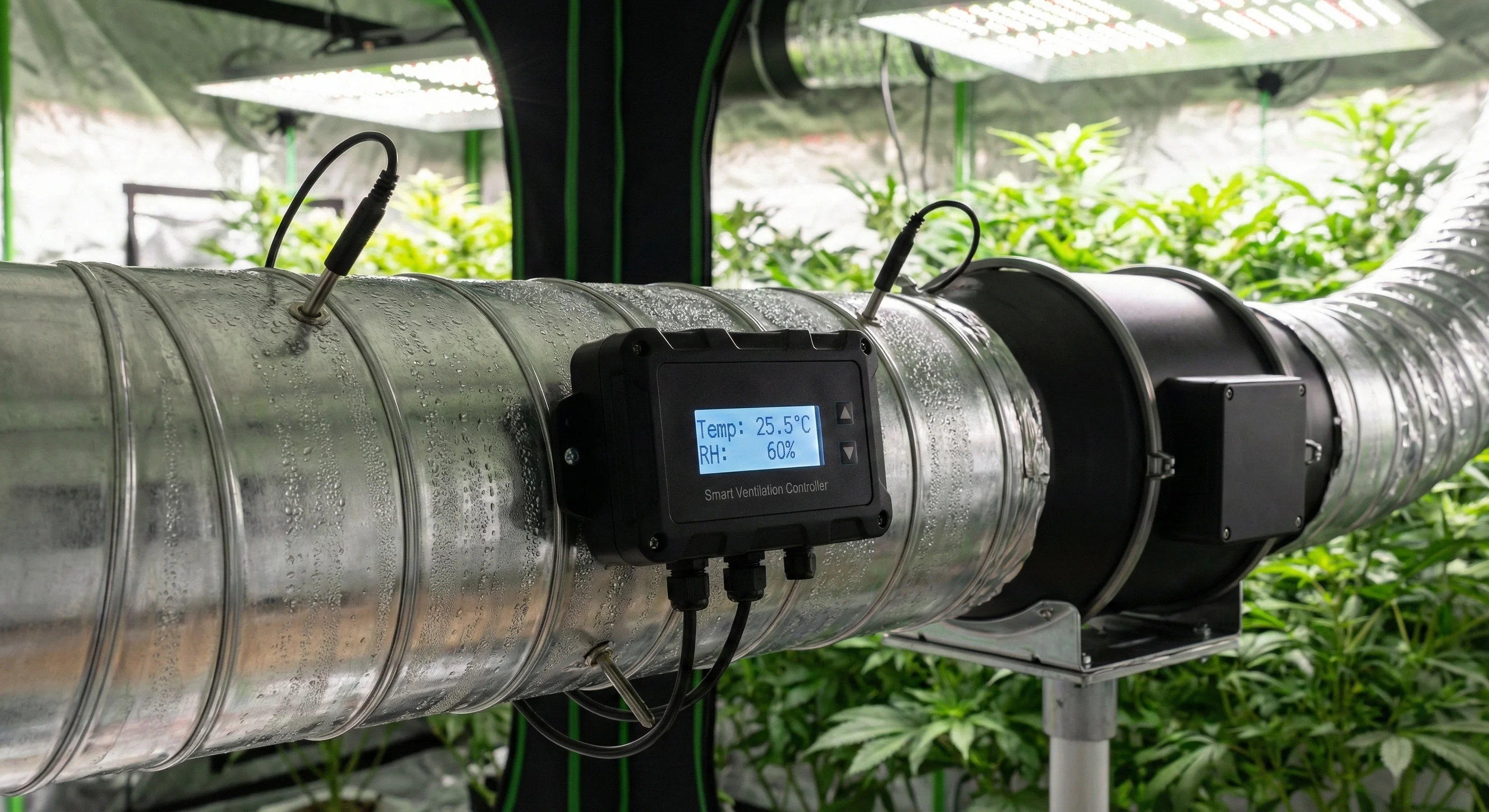
Industrial control devices are typically developed through a sequence of requirements definition, system design, prototyping, validation, DFM, and production preparation. An industrial controller rarely begins as a finished circuit board. It usually starts as a practical problem: a fan must react to environmental conditions, a motor must change speed at the right moment, or a machine must keep operating within defined limits. Turning that need into a manufacturable product requires more than drawing a schematic.
Engineers have to translate operating conditions into measurable inputs, control logic, electrical architecture, mechanical protection, test criteria, and a production method. The strongest development path therefore treats the product as a connected system in which sensing, firmware, enclosure design, sourcing, validation, and assembly affect one another from the beginning.
Turning a Use Case into Engineering Requirements
The first stage in electronic prototype manufacturing is not component placement but requirement definition. For industrial control devices, the design team needs to identify what the equipment senses, what it controls, how quickly it must respond, what power and communication interfaces are available, and what environmental conditions the enclosure will face.
A ventilation controller, for example, may need temperature, humidity, and vapor pressure deficit inputs rather than a single temperature reading. Those inputs then determine sensor selection, connector needs, processor resources, firmware logic, and the number of control outputs.
Requirements also need measurable acceptance criteria. A phrase such as ‘automatic airflow control’ is too broad for engineering unless it is translated into trigger thresholds, motor-control behavior, alarm states, recovery behavior, and user settings.
Mechanical limits matter at the same time because board dimensions, probe locations, mounting points, heat paths, and ingress protection targets can change the electronics. Early agreement on these relationships reduces the risk of discovering late that a useful function cannot fit inside the intended housing or cannot be tested consistently.
Prototypes Reveal Interactions That Schematics Cannot
A schematic can confirm connectivity, but electronic prototype manufacturing exposes physical and behavioral interactions in industrial control devices. Early units can show whether sensor readings remain stable near switching electronics, whether an EC motor reacts correctly to control signals, whether the power architecture tolerates load changes, and whether firmware handles multiple triggers without unintended state changes.
Prototype rounds also make it possible to compare alternative sensors or component packages before tooling and volume purchasing make changes more expensive. Functional testing at this stage works as an iterative engineering loop, not as a ceremonial checkpoint. A test result can lead to a firmware adjustment, PCB revision, connector change, or housing modification, followed by another build.
The objective is not to make a prototype look like a finished retail product as early as possible; it is to remove uncertainty in the order that most efficiently protects later manufacturing. That distinction is important because a visually polished sample can still hide unstable sensing, poor cable routing, difficult assembly, or parts that create supply risk.
Firmware, Enclosure, and DFM Converge
Once the core functions are proven, electronic prototype manufacturing shifts toward manufacturability, and industrial control devices begin to resemble their production form. Minewing’s automated ventilation-controller project illustrates this convergence. The device was developed for inline duct fans and HVAC applications in settings such as hydroponic grow tents, server cooling rooms, and smart basements.
Minewing handled firmware for EC motor control, coordinated critical sensor sourcing, and optimized the housing mold while the controller used temperature, humidity, and VPD probes with preset triggers to automate airflow. The enclosure was not treated as decoration around the circuit.
Mold changes targeted an IP44 rating, vibration durability, and lower manufacturing cost, so mechanical decisions had to remain compatible with sensor access, control hardware, and assembly. DFM review at this stage can also examine fastener count, connector accessibility, PCB support, cable strain, molding features, and assembly sequence. Cost optimization becomes more reliable when it is tied to these concrete design choices before the design is frozen.
Validation Creates a Repeatable Production Process
The final purpose of electronic prototype manufacturing is to establish repeatability beyond a single working sample of industrial control devices. Validation therefore expands from functional behavior to production readiness: components and vendors are checked, test methods are defined, assembly steps are stabilized, and the design is examined for variation that could affect quality.
Development schedules differ with complexity, feature requirements, and certification needs, so the unresolved risk in the program determines how many prototype iterations are needed. Minewing‘s ventilation project moved from rapid design validation into stable mass production, demonstrating that the transition unfolds through linked stages.
Requirements, sensing functions, firmware, housing engineering, supply-chain planning, and testing all had to reach a controlled state before volume output made sense. A concept becomes a viable industrial controller when its intended behavior can be measured, its hardware and mechanics can be assembled consistently, and its sourcing and quality controls can support the same result across many units.
Developing an industrial controller from concept is therefore a process of progressively reducing uncertainty. Functional requirements define the architecture; prototypes expose electrical, firmware, and mechanical interactions; DFM turns a working design into an assemblable one; and validation connects the design to repeatable sourcing and production.
The sequence matters because weaknesses discovered after tooling or volume purchasing are harder to correct. Minewing’s sensor-driven ventilation controller provides a concrete example of this progression, moving from a basic speed-control idea to a validated product in which sensing, EC motor firmware, enclosure targets, sourcing, and production preparation were engineered together.
