

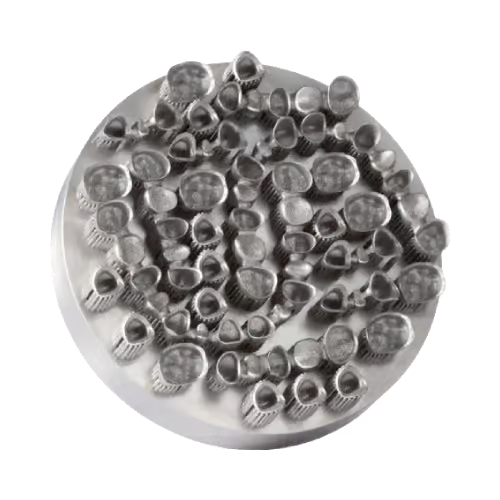
Modern healthcare manufacturing increasingly relies on additive processes to fabricate patient-specific medical implants, dental prosthetics, and specialized surgical instrumentation. Unlike traditional subtractive milling or lost-wax casting, powder bed fusion technology constructs dense metallic components directly from digital CAD data. This digital workflow allows clinicians and technicians to produce complex internal geometries, thin-walled structures, and porous surface textures that promote tissue integration.
Achieving reproducible quality in medical additive manufacturing requires selecting appropriate alloy powders. The chemical purity, particle shape, and grain size distribution of the metal powder dictate the density, mechanical durability, and biological compatibility of the final part. During an SLM 3D print cycle, understanding how specific metals interact with laser thermal energy can help engineers mitigate internal voids, microcracks, and surface degradation that may impact medical regulatory compliance.
Material Capabilities in High-Precision SLM 3D Print Applications
A wide range of biocompatible and technical metal alloys can be processed using selective laser melting. Selecting the optimal material depends on the mechanical stress environment, corrosion exposure, and biological contact duration of the application.
- Cobalt-Chromium (Co-Cr) Alloys
Cobalt-chromium remains one of the most widely utilized materials in digital dentistry and orthopedic joint manufacturing. The alloy provides high hardness, superior wear resistance, and long-term corrosion resistance within bodily fluids. In dental applications, Co-Cr is frequently selected for crown units, multi-unit bridges, partial denture frameworks, and oral stents. A critical advantage of Co-Cr alloys in dental restorations is their thermal expansion coefficient, which matches veneering porcelain to prevent ceramic chipping during firing.
- Titanium Alloys (Ti-6Al-4V / TC4 and Grade 23)
Titanium alloys, particularly Ti-6Al-4V (Grade 5) and Ti-6Al-4V ELI (Grade 23), serve as the primary choice for load-bearing orthopedic implants and maxillofacial reconstruction. Titanium possesses an exceptional strength-to-weight ratio, high fatigue endurance, and a lower elastic modulus than steel, which helps reduce stress shielding in bone tissue. SLM technology enables the creation of open-pore trabecular structures on implant surfaces, such as spinal fusion cages and hip acetabular cups, encouraging bone cellular ingrowth.
- Medical Grade Stainless Steel (316L)
Austenitic 316L stainless steel offers high tensile strength, good ductility, and cost-effective processing. Although less common for permanent implants due to its higher stiffness, 316L is widely used for temporary fixation pins, surgical guide templates, endoscopic tools, and custom diagnostic housing. Its stability during melting makes it suitable for prototype evaluation and clinical tool fabrication.
- Specialty Alloys (Nitinol and Tantalum)
Nickel-titanium (Nitinol) provides superelastic behavior for cardiovascular stents and flexible medical components, while tantalum offers high radio-opacity and extreme biological inertness for specialized medical devices.
Technical Capabilities of Compact Additive Systems
In the industrial additive sector, technology enterprise LiMN 3D supplies metal powder bed fusion systems, specialized powders, and OEM/ODM engineering solutions tailored for aerospace, tooling, and dental healthcare sectors.
For dental laboratories and medical prototype centers seeking compact equipment, the LM-M100D Lite represents an optimized metal 3d printing machine designed for small, complex medical and dental parts. Featuring machine dimensions of 630 × 600 × 850 mm and a total weight of 150 kg, this system integrates easily into space-constrained laboratory environments without requiring major structural modifications.
The LM-M100D Lite operates with a build envelope of Φ100 × 50 mm (with an optional 80 mm height expansion) and utilizes a 300W fiber laser with a scanning speed up to 7 m/s.It can accommodate fine layer thicknesses ranging from 20μm to 60μm, and dimensional accuracy down to ±50μm is achievable under suitable process conditions.
To preserve material purity and prevent oxidation in titanium and Co-Cr powders, the system maintains chamber oxygen levels at or below 100 ppm under continuous Nitrogen or Argon shielding gas. The machine runs on its dedicated TH-3Dprint control software, supporting SLM print workflows for batch dental manufacturing.
Real-World Applications in Healthcare and Dentistry
Metal additive manufacturing supports a wide variety of practical applications across clinical and laboratory settings:
Patient-Matched Dental Frameworks: Automated printing of crowns, coping bridges, and partial dentures directly from intraoral optical scans reduces manual lab labor and turnaround time.
Trabecular Orthopedic Implants: Additive systems build spinal interbody cages featuring integrated porous lattices that mimic human cancellous bone structure.
Customized Trauma Fixation: Surgeons utilize patient-tailored titanium plates and surgical drill guides designed specifically for complex bone reconstructive procedures.
Key Technical Questions Healthcare Equipment Buyers Ask
1.Why is strict oxygen control necessary when printing titanium medical devices?
Titanium reacts rapidly with oxygen at elevated temperatures. Excess oxygen intake during melting causes interstitial embrittlement, reducing the fatigue life and ductility of the implant. Controlling chamber oxygen levels to ≤100 ppm is one measure that can help support consistent mechanical performance.
2.How does layer thickness influence the surface finish of subgingival dental margins?
Thinner layer settings (such as 20 μm) produce smoother surface steps and finer edge clarity. This feature accuracy is critical near crown margins to prevent marginal leakage and minimize manual grinding during post-processing.
3.What post-processing steps are required for metal 3D printed medical implants?
Printed parts typically undergo stress-relief heat treatment in a vacuum furnace, plate separation via wire EDM, support structure removal, surface shot peening, and passivation to ensure optimal corrosion resistance.
Strategic Conclusion for Medical Additive Procurement
Selecting the correct material and equipment platform is essential for manufacturing safe, high-performing medical components. By combining biocompatible alloys such as Ti-6Al-4V and Co-Cr with high-precision, low-footprint SLM systems, medical device manufacturers and dental laboratories can efficiently deliver reliable, patient-customized solutions.
