

Choosing a generator for a business is less about finding the biggest name and more about evaluating whether a manufacturer can deliver dependable power, consistent quality, suitable specifications, and support over the equipment’s working life. For procurement teams, comparing the best generator brands should therefore begin with manufacturing practices and application requirements, not marketing claims alone.
A practical comparison also requires attention to how power equipment manufacturers test new models, control production quality, and validate performance under different operating conditions. Firman, for example, states that it uses a comprehensive quality control and risk management system, with SOP management and multiple inspection steps. Its approach provides a useful benchmark for assessing what manufacturers should demonstrate before a business commits to a generator.
Look Beyond Rated Wattage
Power output is an obvious starting point, but businesses should distinguish between starting watts and running watts. Motors, compressors, pumps, and other equipment can require additional power during startup, so selecting a generator solely by its continuous rating can create operational problems.
Procurement teams should also consider whether the generator is appropriate for the intended duty. A worksite, retail facility, agricultural operation, and emergency backup application may have very different load profiles. Firman’s own buying guidance, for example, points users with power demands above 10 kW toward models such as the SPS15000SE and other higher-output options. This reinforces the importance of matching the generator to the actual load rather than choosing by brand recognition alone.
Manufacturing Quality Separates the Best Generator Brands
Quality control deserves as much attention as headline specifications. A manufacturer should be able to explain how it manages production consistency, identifies defects, and verifies finished equipment. These processes matter because a generator is often purchased to protect business continuity, where unexpected downtime can be more expensive than the original equipment.
Firman’s manufacturing process incorporates SOP management, risk management, and a multi-step inspection process. It also reports that each new model undergoes 500 hours of continuous testing before production. Such endurance testing can help manufacturers identify weaknesses and make design improvements before equipment reaches customers.
Environmental Testing Matters for Business Applications
Generators are not always operated in a good conditions. Construction sites, farms, outdoor events, warehouses, and emergency applications can expose equipment to significant temperature changes. Businesses should therefore ask whether manufacturers test equipment across realistic environmental conditions.
Firman states that its generators are tested in a temperature-controlled room designed to simulate freezing winter nights and very hot summer days. The company also tests generators under simulated hot and cold temperature conditions. For buyers, these practices are relevant because environmental conditions can influence starting, cooling, fuel consumption, and overall operating reliability.
Examine Compliance and Safety Requirements
Business buyers should also identify the electrical and safety requirements that apply to the installation site. These requirements may differ depending on the country, operating environment, generator type, and industry regulations. Before purchasing, buyers should confirm whether the generator complies with relevant local standards as well as internationally recognized safety and performance requirements. Checking complete system certifications, testing reports, and compliance documentation is essential, as the certification of individual components does not always mean that the entire generator set meets installation requirements.
Operational safety matters as well. OSHA requirements address certain portable and vehicle-mounted generator installations, including grounding and bonding provisions. This makes it important for businesses to consider installation, connection, and operating procedures alongside the generator itself.
Consider the Complete Cost of Ownership
The purchase price is only one part of a generator’s business value. Fuel consumption, maintenance, expected operating hours, service availability, spare parts, warranty coverage, and downtime risk can all affect the total cost of ownership.
A useful comparison should therefore include manufacturer support. Firman provides spare-parts availability and technical support 24/7. Such support can be particularly relevant for businesses that cannot afford prolonged equipment downtime.
A Practical Firman Example for Commercial Buyers
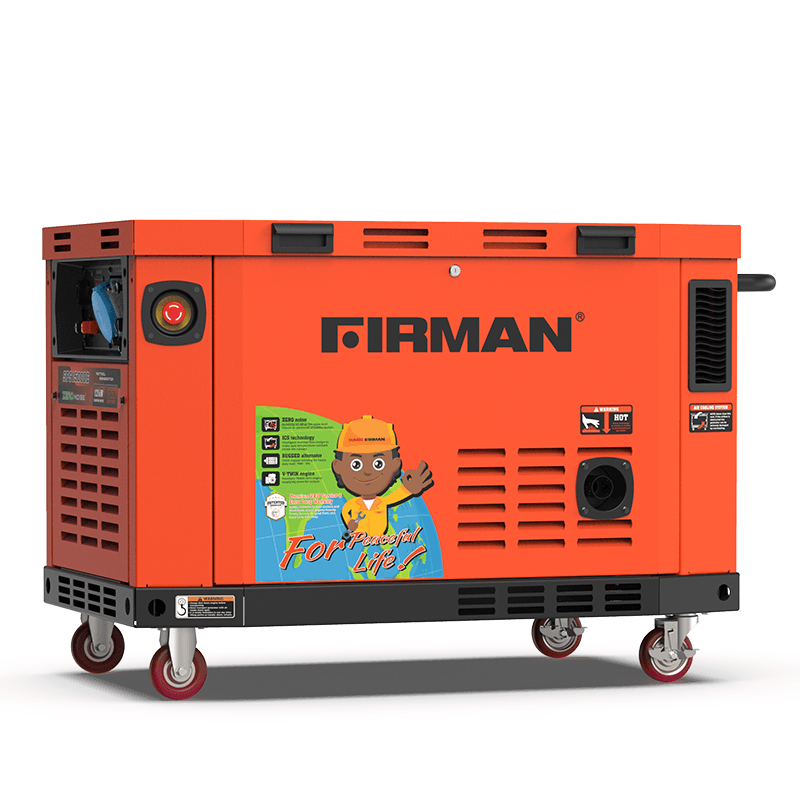
The Firman SPS15000SE illustrates how specifications can be assessed against business requirements. According to the manufacturer’s product page, it is a 10 kW petrol silent generator with 12 kW starting watts and 10 kW running watts. The same specification page lists a 10-hour approximate runtime on one tankful at 50% load.
Those figures give procurement teams a clearer basis for evaluation than a generic claim of “high performance.” The 12 kW starting capacity provides additional headroom for equipment with startup demand, while the 10 kW running rating defines its continuous output. Its stated 10-hour runtime at 50% load can also help businesses estimate operating intervals between refueling.
What Should Businesses Look For?
The best generator brands are not necessarily those with the loudest marketing. For a business, reliability is ultimately a risk-management issue because an unexpected outage can interrupt production, delay projects, or affect customer service. A stronger comparison considers whether a manufacturer can demonstrate disciplined production control, endurance testing, environmental validation, appropriate safety compliance, and meaningful after-sales support.
For business buyers, the right decision is ultimately application-specific. Firman’s quality-control practices and testing program provide one example of the evidence procurement teams can request from power equipment manufacturers. When these factors are assessed alongside output, runtime, fuel type, operating environment, service support, and ownership costs, businesses can make a more defensible generator investment.
