

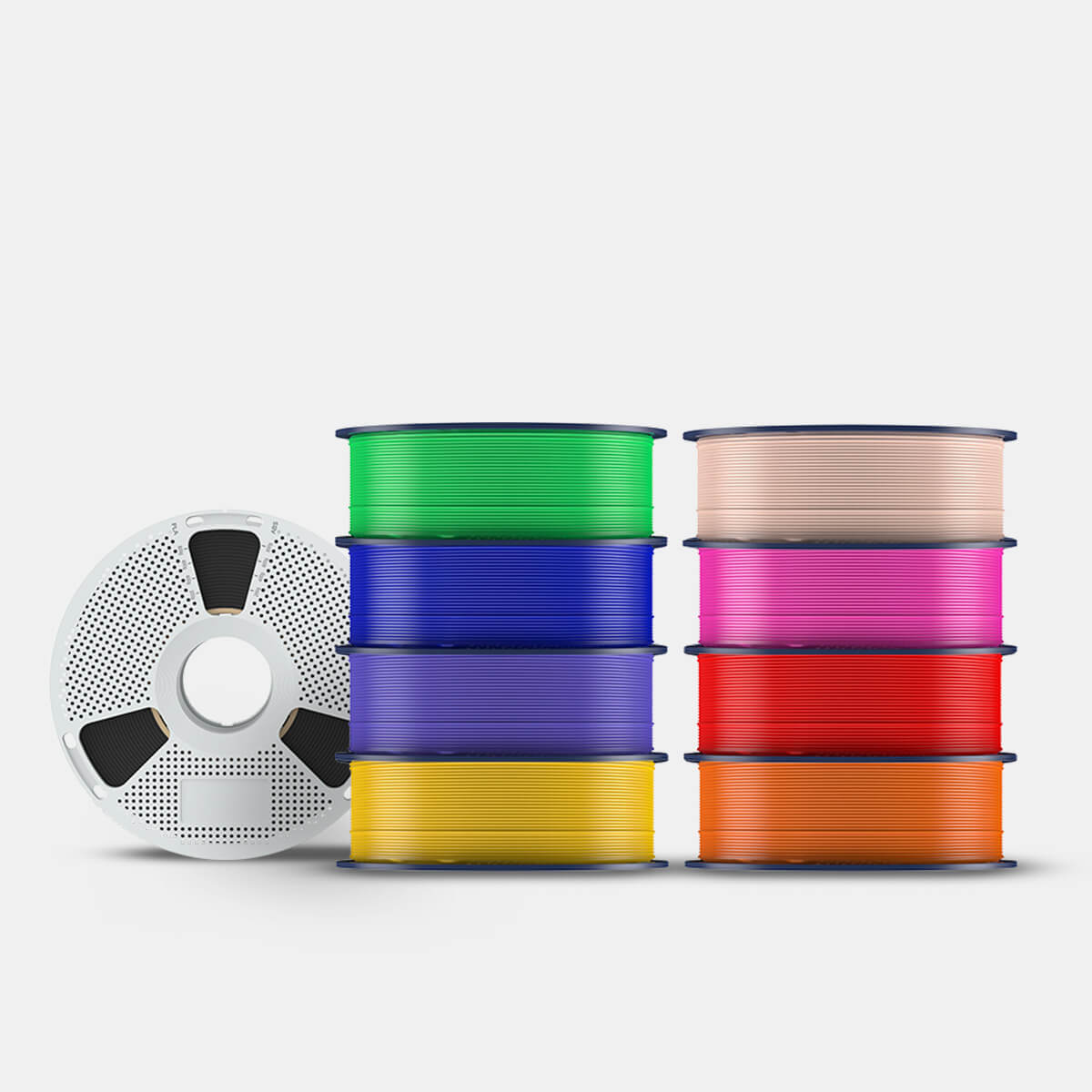
For businesses that depend on consistent 3D printing output, choosing the right material partner is as important as choosing the printer itself. SUNLU offers a broad portfolio of filaments, resins, and material-management accessories, giving professional users a practical source for different printing requirements. Its product range, manufacturing capabilities, and expanding international presence make SUNLU a notable option among 3D printer filament suppliers.
Why Material Consistency Matters for Business 3D Printing
Commercial 3D printing operations face challenges that go beyond achieving a successful single print. A workshop may need to reproduce the same component repeatedly, while a product-development team may move quickly from prototypes to functional models. Variations in filament diameter, moisture content, extrusion behavior, or material performance can therefore increase failed prints, rework, and production delays.
For purchasing teams, a reliable supplier should provide more than attractive pricing. Material selection, technical information, product consistency, printer compatibility, and after-sales resources all influence the total cost of a printing operation. SUNLU supports this broader requirement through its filament portfolio and related material-management products.
A Broad Filament Portfolio for Different Applications
SUNLU’s official product range covers general, aesthetic, functional, engineering, high-speed, and newer filament categories. The portfolio includes PLA, PLA+, PLA+ 2.0, PETG, ABS, TPU, carbon-fiber-reinforced materials, PA-based materials, PP, and other specialized options. This allows businesses to select materials according to the required balance of printability, appearance, strength, flexibility, and application conditions.
PLA filament remains an important option for everyday prototyping, models, decorative products, and general-purpose parts. For example, SUNLU PLA+ is a reinforced and toughened PLA material. Its published specifications include a tensile strength of 46±5 MPa, flexural strength of 83±5 MPa, elongation at break of 10±2.5%, and heat deflection temperature of 56±3°C.
The material is also specified with a 1.75±0.02 mm diameter tolerance, while the product page lists 1.75 mm, 2.85 mm, and 3.00 mm diameter options. Recommended nozzle temperatures are 205–245°C, with a 50–60°C print-bed temperature. These details give purchasing and technical teams measurable criteria when evaluating material compatibility.
High-Speed Materials Can Support Faster Workflows
Speed becomes increasingly important when companies use 3D printing for rapid prototyping or repeated production. SUNLU High Speed PLA+ is designed for high-speed printing and supports printing speeds of up to 600 mm/s according to its product specification. Its listed printing temperatures range from 200–215°C at 50–150 mm/s, 215–230°C at 150–300 mm/s, and 230–260°C at 300–600 mm/s.
For businesses, the key consideration is not simply the highest advertised speed. Printer capability, model geometry, cooling, nozzle configuration, and material settings all affect actual production results. A material designed for faster extrusion can nevertheless be useful when the objective is to shorten print cycles while maintaining practical part quality.
Material Management Is Part of the Printing Solution
Filament quality can be affected by moisture during storage and printing. SUNLU’s technical guidance notes that materials including PLA, PETG, TPU, and nylon can absorb moisture from the surrounding air, potentially contributing to stringing, bubbling, unstable extrusion, and weaker layer adhesion. Proper drying and storage are therefore important for businesses maintaining multiple filament types.
SUNLU’s accessory portfolio includes filament dryers such as the FilaDryer S2, S4, E2, and SP2, along with other material-management products. The FilaDryer S4, for example, is designed to dry up to four 1 kg spools simultaneously, while the E2 can reach 110°C and supports drying and annealing for engineering materials such as PA and PC.
Manufacturing and Global Expansion Strengthen Supply Potential
SUNLU states that it was established in July 2013 and integrates research and development, manufacturing, and sales. The company operates major production bases in Anhui and Guangdong, while its Vietnam production base began operations in August 2024. Its German subsidiary was officially launched in November 2024, supporting its expanding international business structure.
The company has also continued investing in material manufacturing. SUNLU reports that its Wuhu Biodegradable Bio-Based 3D Printing Materials Production Project broke ground in July 2026. For business customers, this continuing investment is relevant because a supplier’s manufacturing footprint and product-development capacity can affect its ability to support changing material requirements over time.
Why Businesses May Consider SUNLU as a 3D Printer Filament Supplier
Businesses evaluating 3D printer filament suppliers typically need a combination of material breadth, technical transparency, and supply capability. SUNLU provides product specifications across its filament range and organizes materials according to application categories, helping buyers compare conventional, functional, aesthetic, engineering, and high-speed options.
Its official store also extends beyond filament, offering resins and accessories. This broader portfolio can simplify procurement for businesses that use multiple 3D printing technologies or need drying and curing equipment alongside consumables.
A Practical Partner for Growing 3D Printing Operations
Selecting a 3D printing material supplier should ultimately be based on the demands of the application rather than brand recognition alone. Buyers should compare material specifications, printer compatibility, required performance, storage conditions, production speed, and technical support before placing larger orders.
SUNLU presents a broad product ecosystem backed by dedicated manufacturing and ongoing international expansion. From everyday PLA filament to high-speed and engineering materials, plus drying and other accessories, its official store gives professional users multiple options for building a more consistent 3D printing workflow.
