

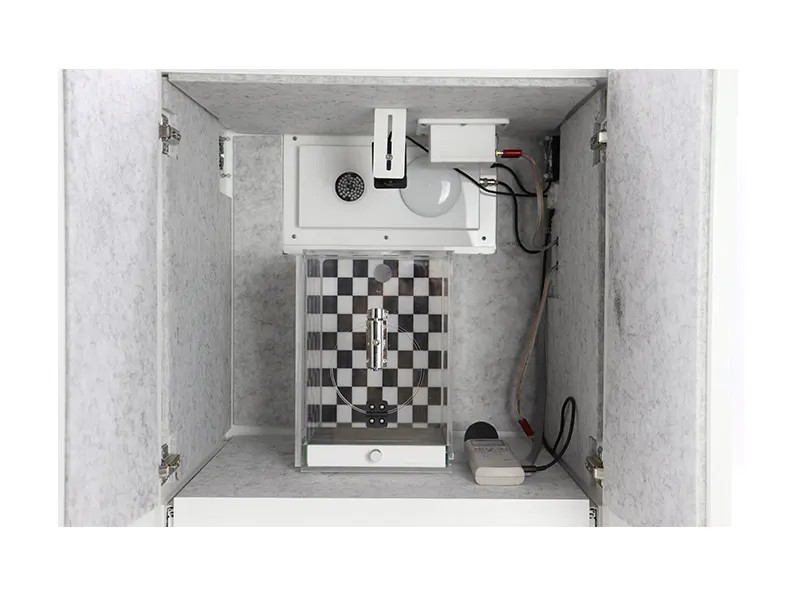
Before a new fear-learning study begins, researchers need to look beyond whether a chamber can deliver a stimulus. The setup should support the intended conditioning protocol, capture freezing behavior, distinguish relevant cues, and preserve usable records for later analysis.
Reviewing these points before installation can clarify whether the equipment fits the study design, animal model, and planned experimental workflow.
Clarify the Conditioning Paradigm
Fear conditioning can examine associative learning and memory by pairing a neutral conditioned stimulus, such as a tone or light, with an aversive unconditioned stimulus, such as an electrical foot shock.
Contextual and cued designs address different experimental questions, so the equipment should accommodate the paradigm planned for the study. BioMed Easy describes its system as supporting both contextual and cued fear conditioning in rodents.
Check Stimulus Control
Multiple cues may be required. The Fear Conditioning System supports pure tone, white noise, visible light, infrared light, and foot shock. White noise ranges from 1–130 dB; pure tone frequency spans 100 Hz–18 kHz—both with durations up to 300 s. Light cues range from 0–200 lux, also supporting up to 300 s.
Shock parameters deserve the same attention. The system provides AC from 0.1–4.0 mA in 0.1 mA steps, with software or manual start and stop control. Reviewing these settings alongside the approved study protocol helps researchers assess whether the apparatus fits the required stimulus sequence.
Examine Freezing Detection
Freezing is a central behavioral endpoint in fear conditioning, so researchers should understand how the system identifies it. The SA218 uses an infrared HD camera and video-tracking software to monitor movement.
The camera supports up to 1920 × 1080 resolution at 30 frames per second. The software analyzes movement patterns to identify freezing behavior and distinguish slow horizontal head movement from an actual freezing state.
The system records multiple freezing-related metrics—not just a single score. Outputs include total freezing duration, freezing percentage, number of freezing episodes, first freezing duration, longest freezing duration, freezing onset time, and experiment duration—supporting diverse analyses without altering acquisition settings.
Review the Contextual Design
Context can be an important variable in associative fear studies. The system uses easy-to-replace acrylic plates with different default patterns, including grey, white, chessboard, and vertical stripes.
Interchangeable plates allow researchers to create distinct environmental contexts for experiments involving contextual learning, discrimination, generalization, or memory retrieval.
The chamber is configured for both mice and rats. The listed operant chamber measures 20 × 20 × 27 cm for mice and 27 × 27 × 32 cm for rats. A removable feces and urine tray is included, supporting routine cleaning between experiments.
Compare Channels and Workflow
Throughput can become relevant when a laboratory plans larger cohorts or multiple experimental conditions. The system supports multiple channels and can be expanded to 16 channels.
Each modular slave unit operates as an independent single-channel system, while the software provides independent signal detection and separated channel operation.
Pre-programmed protocols with randomized intervals are also available. Real-time analysis and preview allow researchers to monitor experiments while automatic saving preserves behavioral data and video for later review. These workflow features can be useful when the same experimental sequence needs to be repeated across groups.
Check Integration With Other Research Tools
A fear conditioning study can be integrated with neural recording or stimulation. The system provides TTL outputs for synchronizing with external neuroscience equipment.
Such as optogenetic stimulators, fiber photometry, calcium imaging, EEG, and electrophysiology systems—enabling precise alignment of behavioral events and neural activity.
Data export should also be checked before purchase. Raw data can be exported in CSV or DOC format for further analysis. Built-in sound calibration and simultaneous display of video, animal condition, score, and stimulation state provide additional records for reviewing the experiment.
Consider Species, Configuration, and Support
The ordering options include SA218-M for mice and SA218-R for rats. Researchers should compare the animal model, chamber dimensions, channel requirements, stimulus types, analysis parameters, and external-device connections before selecting a configuration.
These details can be recorded in the study plan so equipment settings remain linked to experimental procedures.
BioMed Easy Technologies is a subsidiary of SANS Biotechnology and develops equipment for animal behavior and neuroscience research. Its R&D and manufacturing center is more than 7,000㎡. It also has CE and ISO9001 certifications and used by 3,000+ universities and 1,000+ research institutes and hospitals globally.
Its portfolio includes fear and emotion, learning and memory, motor coordination, reward and addiction, and related behavioral categories.
For laboratories building broader behavioral research capabilities, the product range also includes separate platforms such as the SA705 Hot Cold Plate for mouse and rat thermal pain studies, extending the portfolio from fear conditioning into thermal nociception work.
A new fear-learning study can build on the SA218’s configurable stimuli, video-based freezing analysis, interchangeable contexts, multi-channel operation, and data export. Review the official specifications and discuss your experimental design, channel requirements, and integration needs with BioMed Easy before equipment selection.
