

Manufacturers rarely upgrade a production transport system simply because newer technology is available. A more practical reason is that existing equipment no longer fits changing production requirements. Higher product variety, different cycle times, tighter positioning requirements and frequent process changes can expose limitations in a conventional conveyor. For battery, automotive, electronics and medical manufacturers, transport technology can influence how effectively workstations operate as one production line.
An intelligent conveyor system becomes worth considering when material movement needs to be coordinated with production rather than treated as a simple transfer task. Before investing, manufacturers should identify specific problems in the current line and determine whether greater transport flexibility would address them.
What Problems Can Signal the Need for an Upgrade?
A conventional conveyor can work well when every product follows the same route at a stable speed. As production becomes more varied, this fixed movement pattern can become restrictive. A workstation with a longer processing cycle may cause products to accumulate, while another station may remain underused.
The same issue can occur when several product variants share one line. Different models may require different processing sequences, inspection points or assembly times. If transport equipment cannot respond independently, engineers may need to add buffers, lifting mechanisms or manual handling to maintain production flow.
When these adjustments become increasingly common, it may be time to assess whether a different movement system would be more suitable.
How Does a Linear Motion System Change Production Flow?
A linear motion system can provide independent control over individual movers instead of requiring every workpiece to follow the same conveyor rhythm. Products can stop, accelerate, decelerate or move between process points according to programmed requirements.
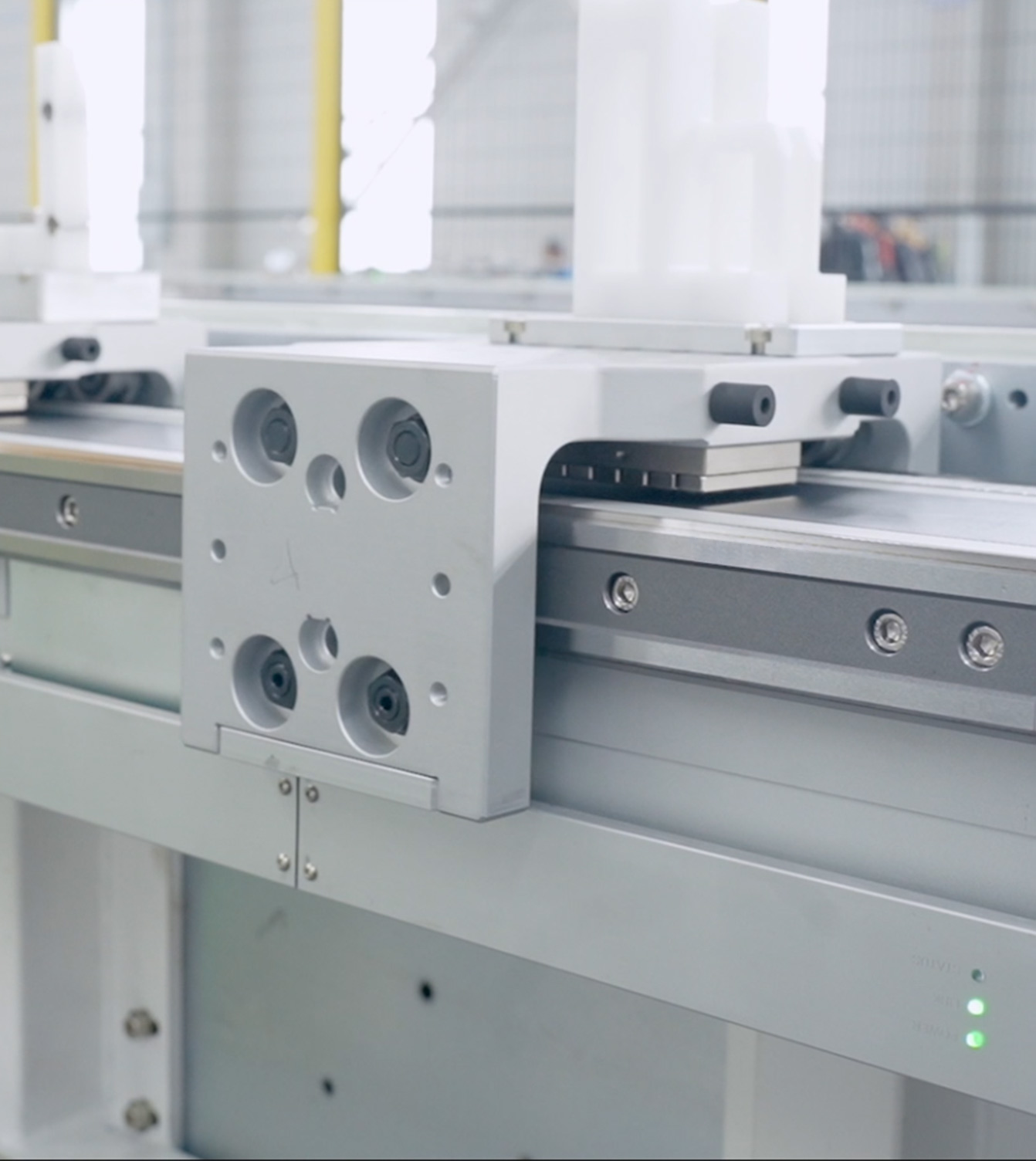
FHS’s Flexible Transport System uses linear motor technology and independently controlled movers to support flexible material transport. Its system information describes applications in new energy, automotive, electronics and medical manufacturing, where production can require controlled positioning and coordinated movement.
This approach can also change how transport and workstations are designed. Rather than building every station around a fixed conveyor sequence, engineers can consider workpiece movement as part of the overall production logic.
When Does Product Variety Become a Transport Issue?
Product variety becomes a transport concern when different models require different production conditions. This can happen in lithium battery manufacturing, automotive component assembly and medical equipment production, where several specifications may share related production lines.
FHS provides FTS configurations for different load and application requirements. Its FTS-MT, for example, is intended for small and medium loads and supports flexible production layouts. Published specifications include a maximum speed of 5 m/s, repetitive positioning accuracy of ±0.01 mm and load options reaching 40 kg.
These specifications should be assessed against the actual process rather than considered in isolation. If a production line requires precise positioning but does not need high transport speed, positioning and control may deserve greater attention during equipment selection.
What Should Engineers Check Before Replacing the Conveyor?
An upgrade should begin with a process assessment. Engineers can examine takt time, workpiece weight, positioning accuracy, product dimensions and the number of processing stations. The current line should also be reviewed for waiting time, repeated handling and points where products need temporary storage.
Control compatibility is another consideration. A new transport system needs to communicate with existing automation equipment, including PLCs(Programmable Logic Controllers), robots, inspection systems and production management platforms.
The FTS-MT information published by FHS lists communication options such as EtherCAT, Modbus/TCP, PROFINET, CC-Link, CANopen and POWERLINK. The system is also designed for modular expansion, which can be relevant when manufacturers expect production capacity or layouts to change.
Which Applications Can Benefit From Flexible Transport?
Flexible transport can be useful where production involves frequent positioning, multiple processing stations or changing product routes. FHS identifies new energy, automotive, 3C electronics and medical manufacturing among the application areas for its FTS technology.
Load requirements also need careful consideration. Different production tasks can require significantly different transport capacities. FHS offers multiple FTS(Flexible Transport System) configurations, including systems designed for heavier loads. Its FTS-HT, for instance, lists a load range from 150 kg to 5,000 kg and a maximum speed of 3.5 m/s.
For manufacturers, selection should therefore start with the workpiece and process requirements. A transport solution suitable for one production line may not fit another, even within the same industry.
Is It Time to Consider a New Transport Architecture?
The need for an intelligent conveyor system is easier to justify when the existing conveyor has become a constraint on production flexibility. Frequent manual intervention, complex buffering, difficult changeovers or limited control over individual workpieces can indicate that the transport architecture deserves closer evaluation.
Manufacturers do not necessarily need to replace an entire line at once. A practical approach is to identify sections where independent movement, precise positioning or flexible routing could address a measurable production issue. Engineers can then compare those requirements with available transport configurations.
For manufacturers considering an automation upgrade, FHS offers flexible transport technologies that can be assessed according to load, speed, positioning and production layout. When these requirements exceed the capabilities of a fixed conveyor, a linear motion system may be worth evaluating as the next step in production automation.
