

Fine adhesive threads between deposits and unwanted droplets after dispensing can compromise product appearance, contaminate nearby components, and increase material waste. These defects often result from a combination of fluid properties, valve response, nozzle geometry, and shutdown timing rather than a single incorrect setting.
Selecting a suitable dispense valve and tuning the process around the adhesive can help manufacturers achieve cleaner deposit separation. Axxonauto develops precision fluid application technologies for production environments where accurate dosing and repeatable results matter.
Why Does Adhesive Keep Flowing in Glue Dispensing?
Stringing occurs when adhesive stretches between the nozzle and the target instead of separating cleanly. It is more common with materials that have high viscosity, elastic behavior, or strong filament-forming tendencies. As the nozzle moves away, the fluid may resist separation and leave a thin strand connecting the deposit to the outlet.
Dripping has a different appearance but can share similar causes. Residual pressure inside the fluid path may continue pushing material through the nozzle after the dispensing command ends. Changes in temperature, material level, cartridge design, and supply pressure can also affect how readily the adhesive flows under gravity or stored pressure.
The first diagnostic step is to observe exactly when the defect occurs. A strand that forms during nozzle withdrawal may point toward material rheology or motion timing, while a droplet that appears after the valve closes may indicate pressure imbalance, delayed shutoff, or residual fluid at the tip. Separating these symptoms helps prevent unnecessary adjustments to unrelated parameters.
How to Tune Fluid Properties and Operating Parameters?
Material temperature can strongly influence dispensing behavior. Higher temperatures often reduce viscosity, allowing adhesive to flow more easily, but excessive heating may alter curing behavior or damage temperature-sensitive formulations. Keeping the material within its specified operating range helps maintain predictable flow from one production cycle to the next.
Supply pressure should be adjusted according to the adhesive and valve mechanism. Excessive pressure can cause material to continue flowing after the trigger ends, while insufficient pressure may produce inconsistent deposits or intermittent delivery. Engineers should make small, controlled adjustments and evaluate both deposit shape and the time required for the material to stop flowing.
Nozzle diameter and standoff distance also affect separation. A nozzle that is too large may deliver excess material, while an unsuitable outlet can encourage adhesive accumulation around the tip. Excessive distance between the nozzle and substrate may stretch the fluid into a filament; reducing the gap within the application’s safe operating range can help produce cleaner detachment.
| Defect | Common cause | Adjustment focus |
| Stringing | Elastic adhesive, excessive nozzle distance | Nozzle retract, temperature, motion timing |
| Dripping | Residual pressure, slow valve shutoff | Pressure control, valve closing time |
How to Match Valve Technology to Adhesive Behavior?
Different glue dispensing systems use distinct mechanisms to control the start and end of fluid delivery. Time-pressure systems are relatively straightforward but can be sensitive to changes in viscosity and supply conditions. Positive-displacement mechanisms provide a different approach to dosing, while jetting technology can deposit material without requiring the nozzle to touch the substrate.
The choice should reflect the required droplet size, material characteristics, production speed, and component clearance. Highly elastic adhesives may need a different shutoff strategy from low-viscosity fluids, and very small deposits leave little room for variation. Testing with the actual material is more informative than relying on valve category alone.
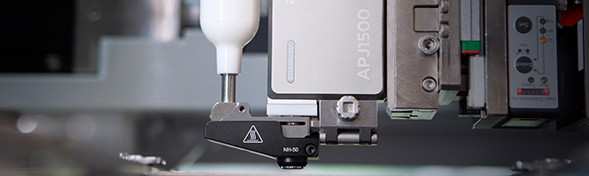
The APJ1500 Piezo Jetting Valve uses a patented short-stroke design and integrated temperature control to support high-speed, non-contact dispensing. Its stated specifications include up to 1,000 dots per second, a minimum dot size of 0.2 mm, and minimum droplets of 1 nL. These features support precise non-contact material deposition, while stringing performance still depends on adhesive rheology, valve settings, and application conditions.
How to Establish Repeatable Shutdown and Maintenance Practices?
A clean deposit depends on what happens at the end of each dispensing cycle. Valve closing time, nozzle withdrawal speed, and movement sequence should be coordinated so the fluid separates without being pulled into a long thread. Some applications benefit from a brief pause before movement, while others require carefully tuned motion to avoid material buildup at the outlet.
Maintenance can prevent gradual changes in dispensing performance. Dried adhesive, partial blockages, worn sealing surfaces, or contamination near the nozzle may disrupt flow and cause deposits to vary over time. Cleaning procedures should follow the material supplier’s guidance, and components should be inspected at intervals suited to the adhesive and production workload.
Production records make troubleshooting more systematic. Tracking material batches, temperature, pressure, valve settings, nozzle condition, and defect frequency can reveal whether stringing or dripping follows a particular change. Axxonauto’s precision dispensing technologies fit into this broader process-control approach, where equipment selection and disciplined validation work together rather than relying on repeated trial-and-error adjustments.
Conclusion
Reducing stringing and dripping requires attention to the entire dispensing cycle, from material conditioning to final fluid separation. Stable temperature, appropriate pressure, suitable nozzle geometry, well-timed valve closure, and routine maintenance each address a different source of unwanted flow.
Shutoff behavior, material compatibility, speed, and dosing accuracy deserve equal attention when manufacturers assess a dispense valve. Axxonauto supports precision fluid application across demanding manufacturing settings, while application trials determine which configuration can meet the actual quality requirements.
FAQs
What Causes Adhesive Stringing After Dispensing?
Stringing commonly results from adhesive elasticity, unsuitable nozzle distance, or movement that stretches the fluid before it separates. Material properties and withdrawal timing should be checked together.
How Can Dripping Be Reduced After Valve Closure?
Review supply pressure, valve closing behavior, fluid temperature, and residual pressure in the delivery path. Adjustments should remain within the equipment and material specifications.
Does A Smaller Nozzle Always Reduce Stringing?
No. A smaller outlet can reduce deposit volume in some applications, but it may also increase flow resistance or clogging risk. Nozzle selection should match the material and required deposit dimensions.
