

A ship can carry hazardous atmospheres into places that appear safe at first glance. Cargo residues, fuel systems, sewage, combustion, and chemical processes can all contribute to dangerous conditions. For crews, the challenge is that toxic gases are often invisible and may have no reliable warning odor. Effective atmospheric monitoring is therefore a key part of onboard risk control.
For vessel operators and safety managers, the focus should extend beyond simply carrying detection equipment. A practical program considers where gases may accumulate, how samples are collected, when measurements are repeated, and how crew members respond to alarms.
Start With the Ship’s Risk Profile
Not every area on a vessel presents the same atmospheric hazards. IMO guidance identifies enclosed spaces such as cargo spaces, fuel tanks, ballast tanks, cargo pump rooms, cofferdams, void spaces, and sewage tanks among areas that can require atmospheric assessment. The exact spaces should be identified according to each ship’s design and operations.
The potential contaminants also depend on the vessel and task. Hydrogen sulfide and carbon monoxide can be relevant in enclosed-space operations, while methane and other combustible gases may become concerns around fuel, cargo, or process systems. Oxygen deficiency is another critical hazard that may exist alongside toxic or flammable gases.
This makes a hazard inventory a useful starting point. Crews can identify spaces, likely gas sources, ventilation characteristics, previous incidents, and routine work activities before deciding what monitoring equipment and procedures are appropriate.
Gas Detector Selection Should Follow the Task
Choosing a Gas Detector should begin with the measurement objective rather than simply selecting the instrument with the largest number of sensors. A personal detector may be appropriate for continuous worker awareness, while pumped sampling can be more suitable when air must be assessed from outside a potentially hazardous space.
Sensor selection deserves equal attention. A device designed for combustible gas monitoring may not provide the measurements required for toxic-gas or oxygen assessment.
Procurement teams should therefore compare the instrument’s target gases, measurement ranges, sampling method, alarm functions, environmental limits, certification, battery performance, and maintenance requirements against the vessel’s actual risk assessment.
Sampling Strategy Is Part of the Safety System
A detector can only provide useful information when the sampled atmosphere represents the space being assessed. Gas concentrations may differ between locations, particularly in areas with complex structures, poor ventilation, or possible gas accumulation.
Pumped sampling can help crews assess an atmosphere before physically entering it. Instead of immediately placing a worker inside the space, a pump and sampling line can draw air toward the instrument. The crew can then evaluate readings before proceeding according to the vessel’s approved entry procedure.
Sampling should also account for changing conditions. Ventilation may alter concentrations, nearby maintenance can introduce contaminants, and cargo or residues may continue releasing gases. The IMO’s 2025 revised recommendations emphasize hazard identification, ventilation, and atmospheric testing using certified and calibrated instruments as components of safe enclosed-space entry.
What to Check Before Crew Entry
A practical pre-entry process should connect atmospheric testing with the vessel’s wider permit and risk-control system. The responsible person should ensure that identified hazards have been addressed, the space has been adequately ventilated, and atmospheric measurements have been obtained before entry.
The 2025 IMO recommendations state that an enclosed space should be treated as unsafe when testing indicates oxygen below 20.9% or the presence of even low levels of flammable or toxic gases.
Crews should also know what happens after an abnormal reading. An alarm should trigger the response established by the ship’s procedures, which may involve stopping work, leaving the space, improving ventilation, isolating hazards, or initiating an emergency response. Detection equipment supports these decisions, but does not replace the vessel’s safety procedures.
A Marine-Focused Gas Detector for Multiple Measurements
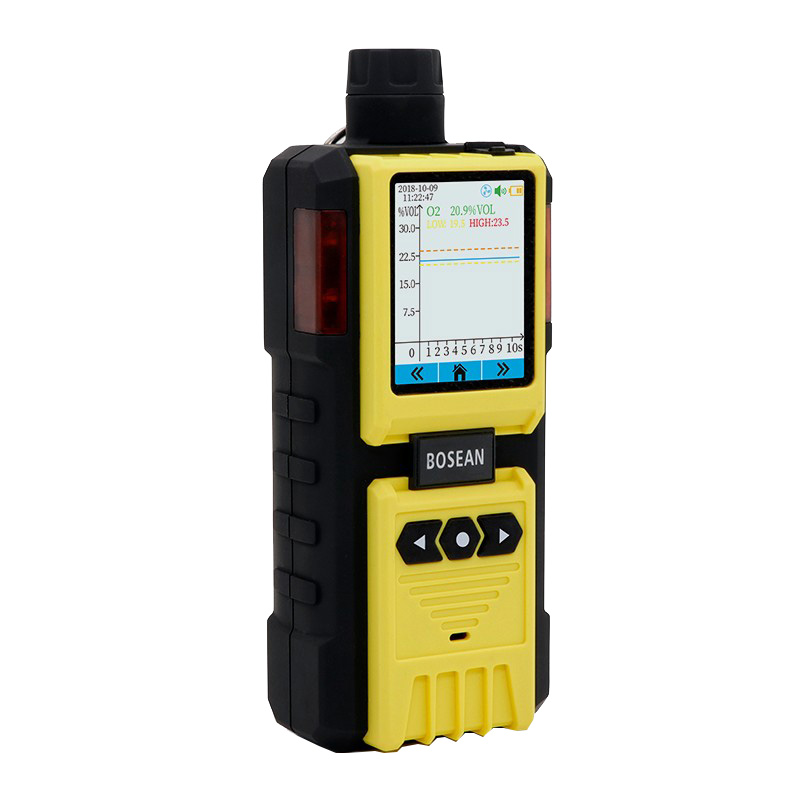
For operators seeking one portable instrument for several atmospheric measurements, the Bosean‘s K-600 Marine 5 in 1 Multi Gas Detector is designed for marine gas monitoring. The model uses gas-pump sampling and is listed by the manufacturer as measuring carbon monoxide, hydrogen sulfide, oxygen, carbon dioxide, and methane.
The unit has a specified accuracy of ≤±5% F.S. and a response time of ≤30 seconds. Its display provides real-time and system-status information, while LED, audio, and vibration alerts indicate gas leakage, faults, low voltage, and pump operation. These features can help crews recognize abnormal conditions while working in demanding environments.
The manufacturer specifies an operating environment of −20°C to 50°C with humidity below 95% RH without dew. The detector uses a 3.7 V, 3200 mAh lithium-ion battery, requires 6 to 8 hours for charging, and provides at least 8 hours of continuous operation without alarming. It has IP65 protection and an Ex ib IIC T4 Gb explosion-proof rating.
The K-600 weighs approximately 400 g with its battery and measures 130 × 67 × 30 mm. It can record up to 1,200 data records and connect to a computer through software for data storage, printing, and analysis. These functions can be useful for operators that want monitoring records to support routine safety management.
Keep Detection Equipment Ready for Use
Reliable monitoring depends on more than purchasing a detector. Equipment should remain ready for deployment, with batteries charged and sampling accessories maintained according to the manufacturer’s instructions. Calibration and functional checks should also be incorporated into the vessel’s established maintenance program.
Crew training is equally important. Users should understand the instrument’s normal display, alarm signals, sampling procedure, limitations, and appropriate response to abnormal readings. A detector that is available but poorly understood cannot provide the same safety value as equipment integrated into a practiced onboard procedure.
Records can further strengthen the program. Documenting inspections, calibration, alarms, maintenance, and relevant atmospheric measurements gives safety managers a clearer picture of recurring risks and equipment condition.
About Bosean
Bosean Tech specializes in industrial safety, environmental monitoring, and professional measurement, with solutions covering portable gas detectors, fixed gas detection systems, sensors, laser rangefinders, and radiation detection equipment. Its technologies support applications across smart mining, smart gas, smart cities, smart industrial parks, energy storage safety, and smart environmental protection.
Guided by the principle of “Precision for Safety, Accuracy for Performance,” the company focuses on reliable, precise products designed around customers’ safety and operational efficiency needs. For marine operators seeking dependable atmospheric monitoring, “Contact Us” to discuss a detection solution suited to your application.
