

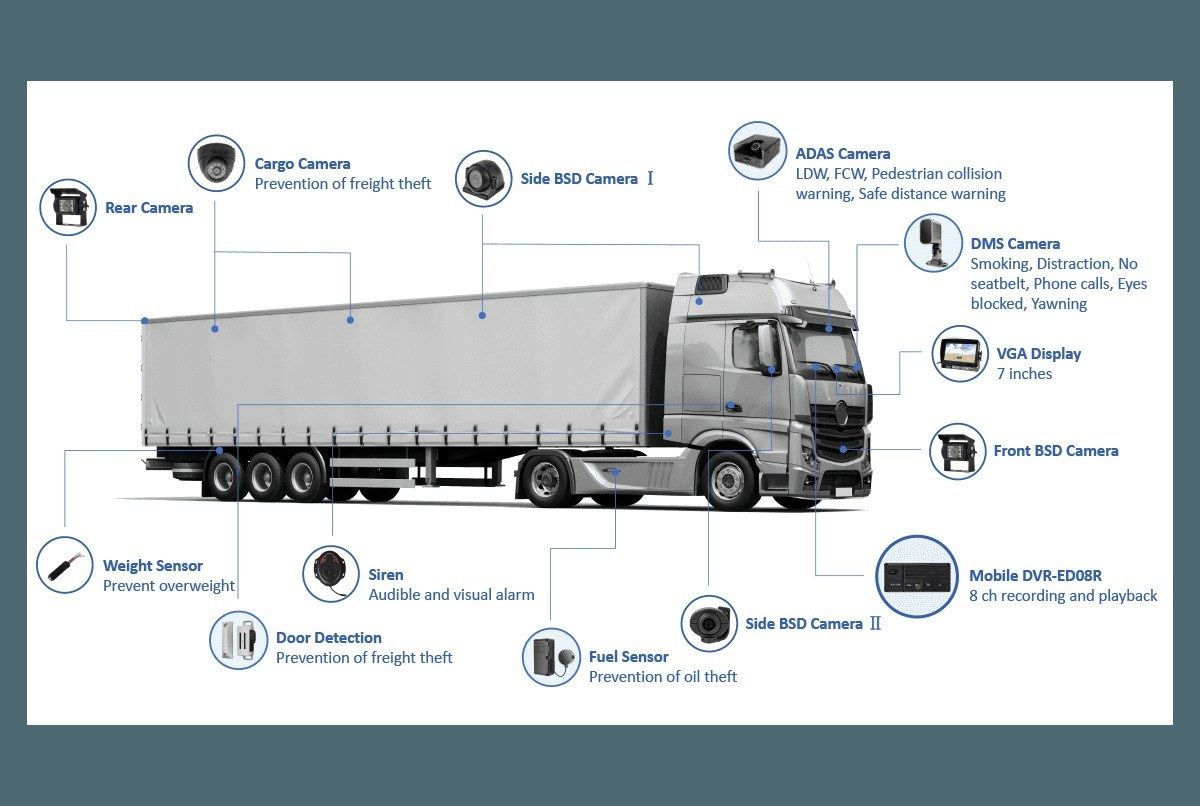
Mixed fleets rarely behave like one standardized operating unit. Heavy trucks, rigid delivery vehicles, vans, service vehicles, and specialist assets may share a dispatch center while following very different routes, duty cycles, risk profiles, and maintenance patterns. Effective transportation fleet management solutions therefore need to provide shared visibility without forcing every vehicle into the same operational template.
The practical objective is to combine location, video, driver events, vehicle status, and workflow data in a way that lets managers compare performance across the fleet while preserving vehicle-specific rules. In that architecture, logistics fleet management software can organize the information, but data quality and operational effectiveness still depends on compatible onboard hardware, consistent data definitions, and a deployment plan that reflects how each vehicle class is actually used.
Build a Common Data Layer Without Losing Vehicle Context
A mixed fleet first needs a shared set of operational signals. Location, ignition state, trip history, stop duration, route deviation, and selected driver events can provide a common baseline across vehicle categories. Once those signals are standardized, managers can compare utilization and exception patterns without confusing a long-haul tractor with a last-mile van or a field-service vehicle.
The same dashboard does not imply identical thresholds. Speed rules, geofences, working hours, camera coverage, and alert priorities can vary by route and vehicle role. Well-designed transportation fleet management solutions allow these differences to be configured while keeping reporting terminology consistent. That balance helps central teams aggregate results and still gives local operators the context needed to act on an alert.
Data quality also depends on how devices are installed and identified. Vehicle IDs, driver IDs, camera channels, sensor inputs, and communication profiles need a repeatable naming convention before data reaches logistics fleet management software. Without that discipline, duplicated assets and mismatched event labels can undermine reports even when the underlying hardware performs correctly.
Role-based reporting helps preserve context after the data is standardized. Utilization, idle time, route adherence, safety events, and maintenance exceptions may be compared across the whole operation, while each vehicle group keeps its own service targets. This avoids a common mixed-fleet problem in which a single KPI rewards one operating profile and unfairly penalizes another that performs a different job.
Match Telematics Hardware to Each Operating Profile
Hardware selection is more effective when it begins with operating risk rather than a single fleet-wide bill of materials. A tractor may need multi-camera recording and driver monitoring, a delivery van may prioritize compact video telematics and frequent location updates, and a support vehicle may need only tracking plus a few digital inputs. Standardization can still be achieved by defining approved device families for each use case.
BSJ Technology supplies AI dashcams, GPS trackers, and multi-channel MDVR systems for commercial fleet applications. Its logistics solution also brings together real-time positioning, driver-behavior monitoring, vehicle-health information, and video surveillance. For a mixed fleet project, these capabilities are most useful when the buyer maps each hardware function to a specific operational requirement instead of installing every available feature on every vehicle.
Connectivity planning must follow the same logic. Cellular coverage, roaming, data volume, video-upload rules, and offline buffering can differ between urban routes and cross-regional transport. Bandwidth can be estimated by vehicle class, with event-based upload policies and fallback behavior defined before rollout. This keeps data costs visible and reduces the risk that remote video functions overwhelm the network design.
Accessory planning can reduce complexity when hardware families are selected. Camera types, antennas, harnesses, sensors, and spare units should be matched to approved vehicle profiles so workshops know which parts belong together. A controlled compatibility list also helps purchasing teams forecast inventory and prevents local substitutions from creating configurations that the central support team cannot reproduce or troubleshoot efficiently.
Govern the Fleet as One Program After Deployment
Once vehicles are online, governance becomes as important as installation. Device versions, alert rules, user permissions, maintenance status, and exception ownership need to be controlled across depots. A central policy can define the minimum configuration, while regional teams retain authority over route-specific thresholds and daily operational responses. That structure keeps expansion manageable as vehicles are added or reassigned.
Integration is another commercial deployment consideration because many operators already use transport-management, dispatch, or customer-service platforms. Where a distributor already operates Wialon, GPSGate, or another platform, BSJ Technology’s devices can be assessed for protocol compatibility without requiring a separate customer-facing application. In practice, buyers still need protocol tests, API mapping, event validation, and commissioning criteria that confirm the required data arrives in the correct format and time sequence.
The strongest mixed-fleet program treats technology as an operating system rather than a collection of devices. Clear vehicle profiles, controlled configuration, compatible interfaces, and measurable response workflows allow management teams to use one data environment without erasing important differences between vehicle classes. That is the point where connected hardware begins to support consistent fleet decisions at scale.
Procurement can use a staged rollout to validate both the technical stack and the management process. A small group from each vehicle class can test data quality, alert usefulness, support response, and integration stability before wider installation. The resulting deployment record gives suppliers, integrators, and fleet managers a common baseline for deciding which issues must be corrected before the next rollout wave. This check also gives finance and operations teams a clearer basis for comparing expansion costs across vehicle groups.
