

Data center networks depend on fast, stable connections between servers, switches, routers, storage systems, and other infrastructure. Transceivers sit at an important point in this architecture by providing the interface between network equipment and the transmission medium. Depending on the application, pluggable modules can support copper or fiber connections and different transmission rates. Their compact design also allows network operators to adapt connectivity without replacing an entire switch or router.
Why Transceivers Matter in Data Center Networks
Modern data centers contain many interconnected network layers, from server access to aggregation and spine connections. A transceiver provides the physical interface that allows compatible equipment to communicate across these links. Cisco describes SFP and SFP+ modules as hot-swappable I/O devices that connect network equipment to either fiber-optic or copper networks.
This modular approach gives infrastructure teams greater flexibility during deployment and maintenance. Instead of changing an entire networking platform when a connection requirement changes, operators can select a suitable pluggable interface for a supported port. The result can be a more adaptable network architecture, particularly where different connection types or link requirements exist.
Choosing the Right Interface for Each Link
Connectivity requirements vary significantly across a data center. Short connections within a rack may use copper-based solutions, while longer links between network layers can require optical fiber. Juniper, for example, categorizes transceiver applications by speed, reach, fiber type, and network position, with different optics supporting connections ranging from intra-rack links to spine-and-leaf and data center interconnect applications.
Compatibility therefore needs to be considered alongside headline data rate. Network planners should verify the supported transceiver type, connector, cable, transmission medium, reach, and equipment compatibility before deployment. Cisco also notes that the wavelength specifications at both ends of an optical link need to match and that cable length must remain within the applicable limit.
How SFP Modules Improve Deployment Flexibility
The small form-factor pluggable design is particularly useful where rack space and serviceability matter. An SFP module occupies a compact interface while allowing network equipment to accommodate different connection requirements. Hot-pluggability is another practical advantage because compatible modules can be installed or removed without shutting down the whole networking device.
For businesses evaluating SFP transceiver module manufacturers, this flexibility should be considered together with product consistency, compatibility, supply capability, and technical support. A module that meets the nominal speed requirement but does not work reliably with the target switch can create additional troubleshooting and replacement costs. Vendor qualification is therefore an important part of procurement.
Reliability and Compatibility Are Operational Priorities
Transceiver selection affects more than initial network installation. Data center operators also need to consider how components will behave during maintenance, expansion, and equipment replacement. Standards compliance and system-level qualification can help reduce interoperability risks. Juniper, for instance, emphasizes testing of qualified pluggable optics at the system level and their integration with networking operating systems.
The same principle applies to copper-based SFP modules. Cisco documentation identifies 1000BASE-T SFP transceivers as hot-swappable and specifies an RJ-45 connection for copper cabling. For business buyers, these details demonstrate why a transceiver should be evaluated as part of the complete network environment rather than as an isolated component.
Where Wintop SFP Transceiver Modules Fit
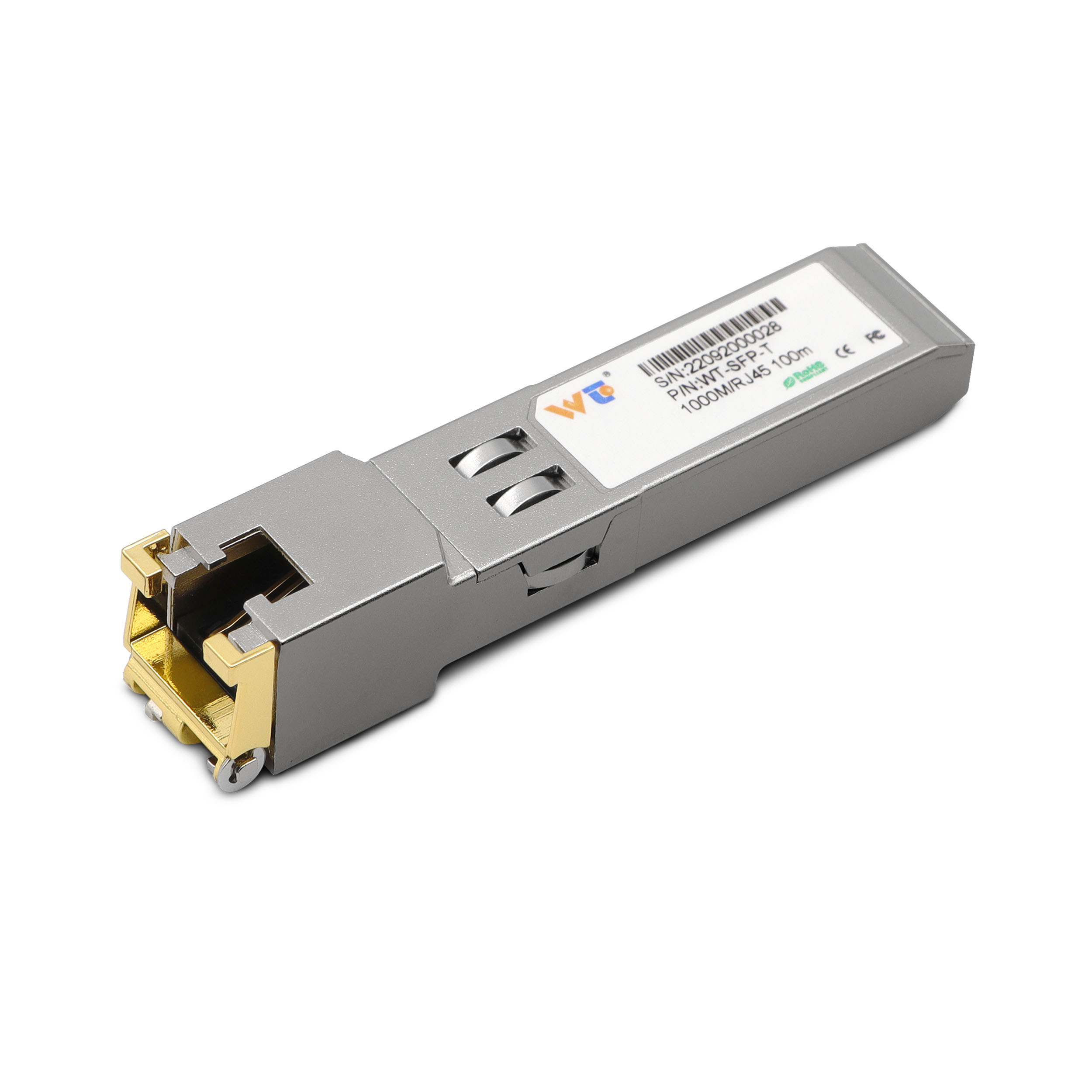
Wintop is a network equipment supplier and national high-tech enterprise involved in the R&D, production, and sales of optical modules and switches. Its WT SFP Transceiver Module is designed around a compact, hot-pluggable SFP footprint and a compact RJ-45 connector assembly.
The product supports data rates up to 1.25 Gb/s for bi-directional data links, while its listed data rate is 1000 Mbps. These characteristics make the module relevant to network environments requiring Gigabit-class connectivity through an SFP interface. For equipment planners, the RJ-45 interface also provides a practical option where copper Ethernet cabling is required rather than a fiber connection.
Planning Transceiver Deployment for Long-Term Growth
Data center connectivity should be planned around current requirements while leaving room for future expansion. Higher-speed optical technologies are becoming increasingly important as traffic volumes grow. Juniper’s current optics portfolio, for example, spans technologies from 1G to 800G, illustrating the wide range of performance levels now used across enterprise, WAN, and data center networks.
That does not mean every connection needs the highest available speed. Using an appropriately rated transceiver for each link can help avoid unnecessary expenditure while maintaining the required performance. Procurement teams can compare transmission rate, interface, reach, compatibility, power requirements, and lifecycle support to determine the most suitable option for each network segment.
Building a More Adaptable Connectivity Architecture
Transceivers are small components, but their role in network architecture is substantial. They provide the physical interface needed to connect networking equipment with the appropriate copper or optical medium, while pluggable designs simplify upgrades and maintenance. For data center operators, selecting the right module can therefore support easier deployment, better interoperability, and more efficient use of existing infrastructure.
Wintop is a network equipment supplier and national high-tech enterprise specializing in the R&D, production, and sales of optical modules and switches. Its WT SFP Transceiver Module supports a 1000 Mbps data rate, up to 1.25 Gb/s bi-directional data links, a hot-pluggable SFP footprint, and a compact RJ-45 connector assembly. Contact Wintop to discuss suitable SFP transceiver solutions for your network equipment and data center connectivity needs.
